














1.0 Introduction: Gyeonggi Province as the Core of Seoul’s Metropolitan Expansion
As the vast province encircling the capital, Gyeonggi’s development is inextricably linked to the economic vitality and residential stability of the entire Seoul metropolitan area. Its strategic planning is not merely a matter of local growth but a critical component of national urban and industrial strategy. As Seoul continues to expand and decentralize key functions, Gyeonggi Province is evolving from a satellite region into a collection of powerful, self-sustaining economic hubs. This transformation is driven by a wave of ambitious urban development, high-tech industrial, and next-generation infrastructure projects.
This report provides a data-driven synthesis of these major projects, offering a strategic overview for planning and investment decisions. To capture the diverse and distinct development trajectories within the province, the analysis is segmented into two core regions: Northern Gyeonggi, characterized by large-scale residential expansion and enhanced connectivity to Seoul, and Southern Gyeonggi, emerging as a global high-tech industrial powerhouse.
2.0 Strategic Context: The Interconnected Development of Seoul’s Southwest Corridor
Before analyzing projects within Gyeonggi Province, it is essential to understand the development dynamics in Seoul’s Southwest region (Seonamkwon). This area, encompassing districts like Yeongdeungpo, Guro, and Gangseo-gu, serves as a critical economic and transportation gateway to the western and southern parts of Gyeonggi. The major railway and urban renewal projects initiated here create powerful ripple effects, setting development precedents and extending crucial infrastructure links that directly shape the growth of adjacent Gyeonggi cities.
Enhanced Railway Connectivity
Several major railway projects are underway to strengthen the link between Seoul’s core and its southwestern periphery, significantly improving commuter access and logistical capacity.
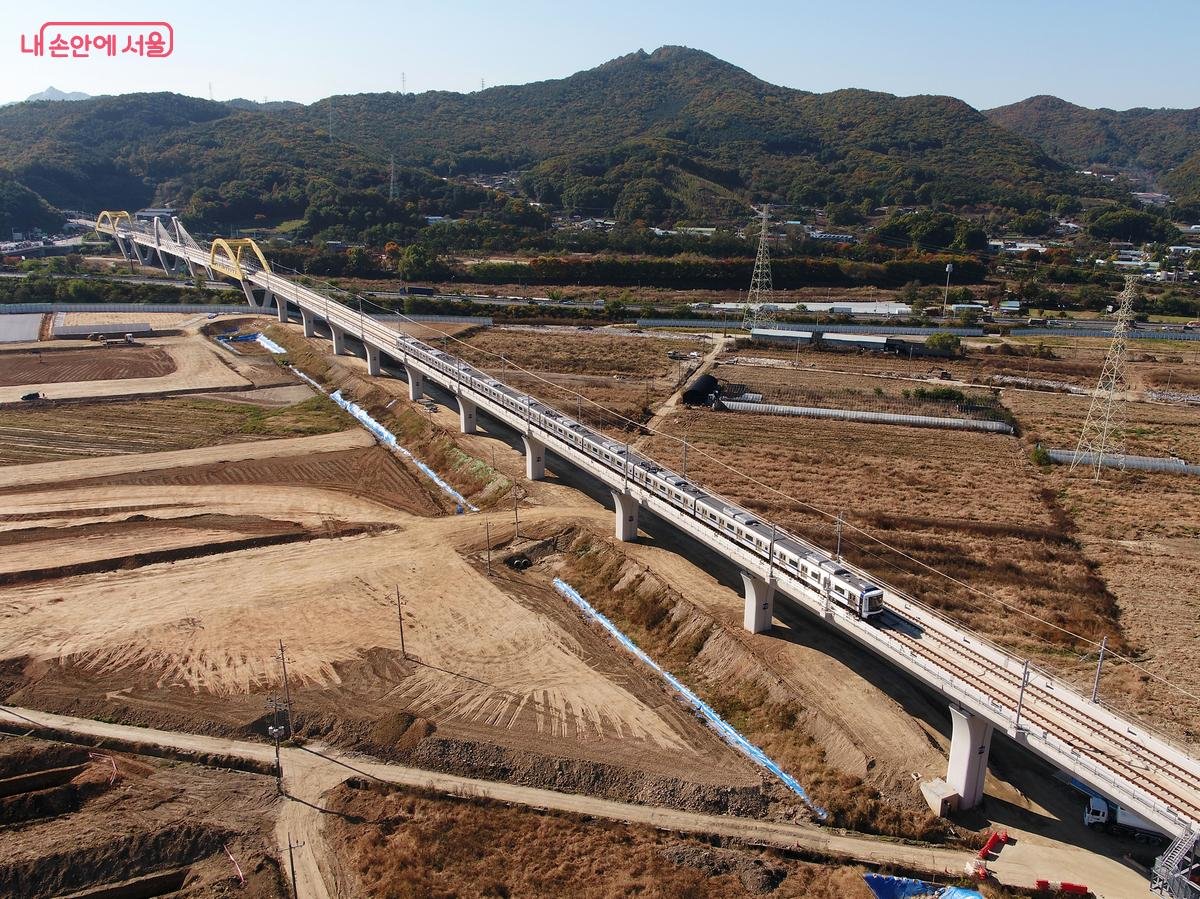
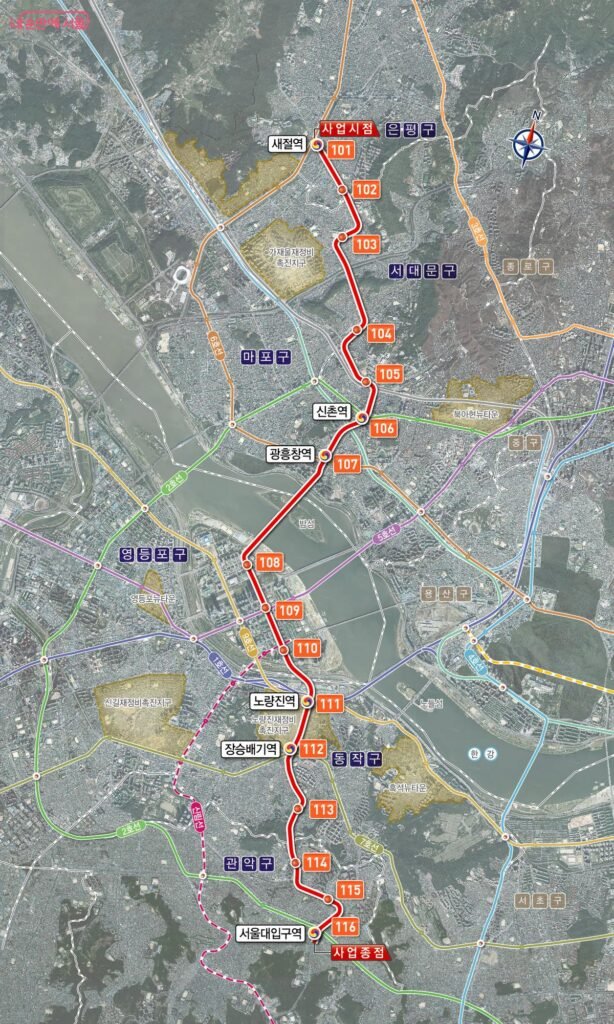
- Sinansan Line: This line establishes a vital north-south artery connecting Yeouido in Seoul with Siheung and Hwaseong in Gyeonggi. Following a collapse accident, the project’s overall completion is now projected for approximately 2030, a delay of 3-4 years. With a projected progress rate of approximately 64.3% by September 2025, a priority opening of the Seohwaseong-Wonsi section is planned for the first half of 2026 to alleviate regional transportation strain.
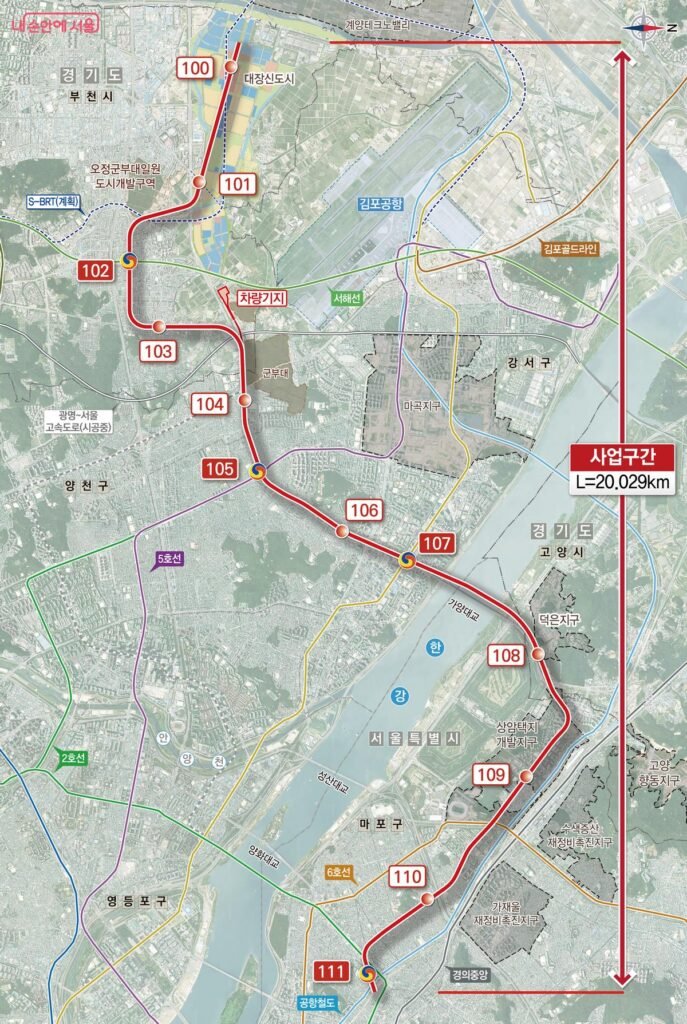
- Daejang-Hongdae Line: This mixed-model private investment project (BTO/BTL) will connect the Daejang New Town district with key Seoul hubs, including Gangseo-gu Office and Hongik University. With a potential groundbreaking in late 2025, the target completion date is 2031. The line is strategically designed to improve job accessibility to major business districts such as Yeongdeungpo, Yeouido, Magok, and Gangnam, directly benefiting residents in adjacent Gyeonggi areas.
Key Urban and Industrial Renewal Projects
The redevelopment of aging industrial and residential areas in Southwest Seoul provides a template and economic anchor for neighboring Gyeonggi’s industrial and urban planning.
- Industrial Area Redevelopment: The “2040 Seoul Industrial Area Basic Plan,” scheduled for announcement in the first half of 2026, aims to revitalize aging industrial zones, with a significant focus on areas in Yeongdeungpo and Guro. This plan is expected to modernize the industrial base and create higher-value jobs at the border of Seoul and Gyeonggi.
- National Assembly Avenue Undergrounding: This transformative project involves moving a major arterial road underground to create a large linear park on the surface. Road facilities are scheduled for completion by 2029, with the park to be finished by 2030. This initiative is set to significantly improve the residential environment and increase the commercial potential of the surrounding Yangcheon-gu and Gangseo-gu areas.
- Onsu Industrial Complex Restructuring: The plan for the Onsu Industrial Complex involves comprehensive deregulation and targeted support to restructure it into a modern hub for advanced manufacturing, fostering a high-tech corridor that extends into the neighboring city of Bucheon.
These foundational projects in Seoul create the necessary momentum and infrastructure backbone for the large-scale developments now unfolding across Gyeonggi Province.
3.0 Analysis of Northern Gyeonggi Province Development Hubs
The development of Northern Gyeonggi is primarily characterized by the creation of large-scale residential new towns designed to accommodate the capital region’s growing population. This expansion is supported by significant investments in transportation infrastructure to improve connectivity with northern Seoul and the strategic redevelopment of former US military bases, which are being repurposed for extensive urban and industrial use.
3.1 Paju City: Expansion Fueled by New Town Growth and Strategic Redevelopment
Paju City is experiencing rapid growth through the completion of its massive Unjeong New Town and the ambitious redevelopment of several returned U.S. military bases.
- Unjeong New Town: This major residential project is nearing completion. Districts 1 and 2, comprising 45,000 households, are fully occupied. District 3, with another 45,000 households, is in the process of sequential move-ins, which will continue until 2028.
- Unjeong Techno Valley: The development method for this industrial hub has been shifted from a private-led model to public development. A feasibility study is currently underway and is scheduled for completion by December 2025.
- Capital Region Second Ring Expressway (Gimpo-Paju Section): This critical highway link is 52% complete, with an expected opening in December 2027. It will feature two new key access points for Paju: the Unjeong Interchange (IC) and the Songchon Interchange (IC).
- Redevelopment of Returned U.S. Military Bases: Several former military sites are being transformed into new residential and industrial zones, adding significant capacity to the city.
| Camp Name | Location | Development Type | Planned Scale | Key Milestones/Target Dates |
| Camp Edwards | Wollong-myeon | Urban Development | Approx. 7,000 households | Project implementation approval in 2026 |
| Camp Howze | Jori-eup | Urban Development | 5,300 households | Compensation to begin in 2026 |
| Camp Giant | Munsan-eup | Urban Development | Approx. 6,500 households | Project implementation approval in 2026 |
| Camp Stanton | Gwangtan-myeon | Industrial Complex | Industrial Complex Development | Industrial park plan approval in 2026; Compensation & Construction from 2026-2028 |
3.2 Goyang City: Leveraging GTX Connectivity for Large-Scale Urban Projects
Goyang City’s development is centered on leveraging the new GTX-A express rail line to anchor major commercial, cultural, and residential projects.
Ilsan Area Projects
The area around KINTEX is being transformed into a major MICE (Meetings, Incentives, Conferences, and Exhibitions) and cultural hub.
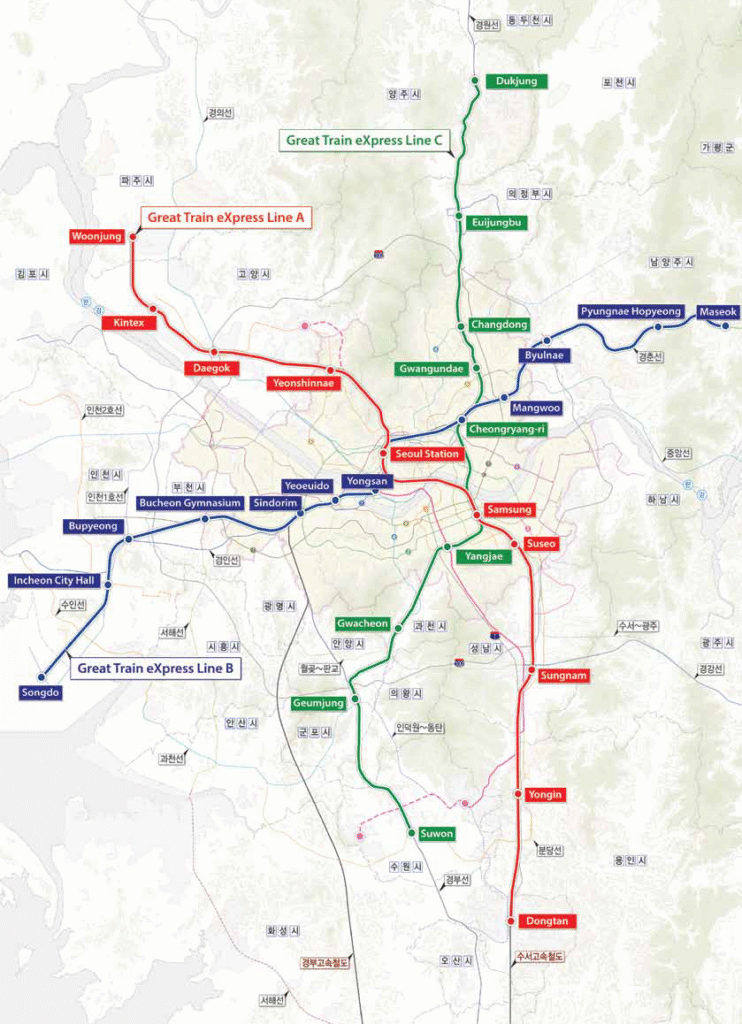
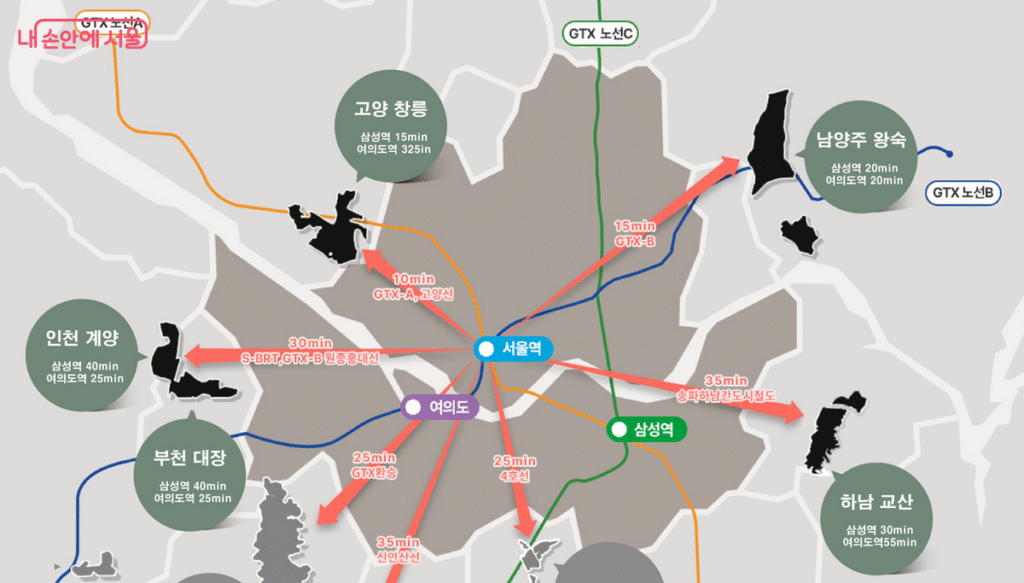
- GTX-A Line: The line is currently operational to Seoul Station. The Unjeong-Suseo stop is planned for June 2026, and the full route including the crucial Samsung Station connection is slated for 2028.
- Ilsan Techno Valley: With construction progress at 35%, phased land sales for this tech hub are scheduled to begin in October 2025, with a target completion date in the second half of 2027.
- K-Culture Valley (formerly CJ Live City): After delays, the project is moving forward. The Live Nation consortium was selected as the preferred bidder in October 2025, with a construction start goal of May 2026 and completion targeted for 2030.
- KINTEX 3rd Exhibition Hall: To expand its capacity as an international convention center, construction on a third exhibition hall is set to begin in December 2025 and finish by 2030.
Deogyang-gu Area Projects
This area is being developed as a major transportation and residential hub centered around Daejeo Station.
- Changneung New Town: This new town will supply 38,000 households, with initial occupancy targeted for December 2027 and overall project completion targeted for 2029. It will be served by the new GTX-A Changneung Station, planned for a 2030 opening.
- Daejeo Station Area Development: District designation for this development is planned for 2026, with an occupancy target of 2031. Daejeo Station is poised to become a major regional interchange, connecting the GTX-A, Seohae, Gyeongui, and Line 3 trains.
3.3 Gimpo City: Transformation into a “Compact City” with Enhanced Rail Connectivity
Gimpo is undergoing a major transformation with several large-scale urban projects and critical new railway lines designed to resolve its chronic transportation issues.
- Gimpo Hangang 2 District (Compact City): This massive LH-led project will create 46,000 households. Following district designation in July 2024, the development timeline anticipates plan approval by December 2026 and project completion by 2033.
- Pungmu Station Area Development: This 6,500-household project is scheduled to start site construction in November 2024 and is expected to be completed by December 2027.
- Hangang Cinema Polis Industrial Complex: An ongoing project (2009-2026), this complex plans to begin apartment sales in June 2025.
- Gimpo Environmental Regeneration Innovation Complex: This project will supply 9,500 households, with urban district designation targeted for December 2026.
Critical Railway Projects
- Western Capital Region Express Railway (GTX-D): This new express line will run from Janggi, Gimpo to Bucheon Stadium. The preliminary feasibility study is expected to pass in July 2025.
- Seoul Metro Line 5 Extension: A crucial project to improve connectivity with Seoul, this extension from Banghwa to Gimpo is currently undergoing a preliminary feasibility study.
3.4 Yangju City: Emerging as a Strategic Northern Hub
Yangju is rapidly developing as a key northern hub with significant residential, industrial, and infrastructure projects.
- Urban Development:
- Okjeong District: A major new town with 45,000 households.
- Hoecheon District: A 24,000-household district with phased sales continuing until 2030.
- Yangju Station Area Development: A 3,700-household project where Phase 1 is complete and Phase 2 is partially complete (43%).
- Industrial and Economic Development:
- Yangju Techno Valley: Land sales are scheduled for 2026, with a completion target of late 2026.
- Eunnam General Industrial Complex: Currently for sale with 24% of lots sold, this complex is targeting completion by late 2027.
- Transportation Infrastructure:
- GTX-C Line: Construction for this major express rail line is currently delayed.
- Seoul Metro Line 7 Extension (Dobong-Okjeong): The extension will be completed in phases, with service to Go-eup targeted for late 2027 and the final extension to Okjeong by 2031.
- Seoul-Yangju Expressway: Construction is planned to start in the second half of 2026, with the expressway opening in 2031.
3.5 Namyangju City: Large-Scale Housing Supply and Supporting Road Infrastructure
Namyangju is the site of one of the largest housing supply initiatives in the capital region, supported by extensive road and rail infrastructure enhancements.
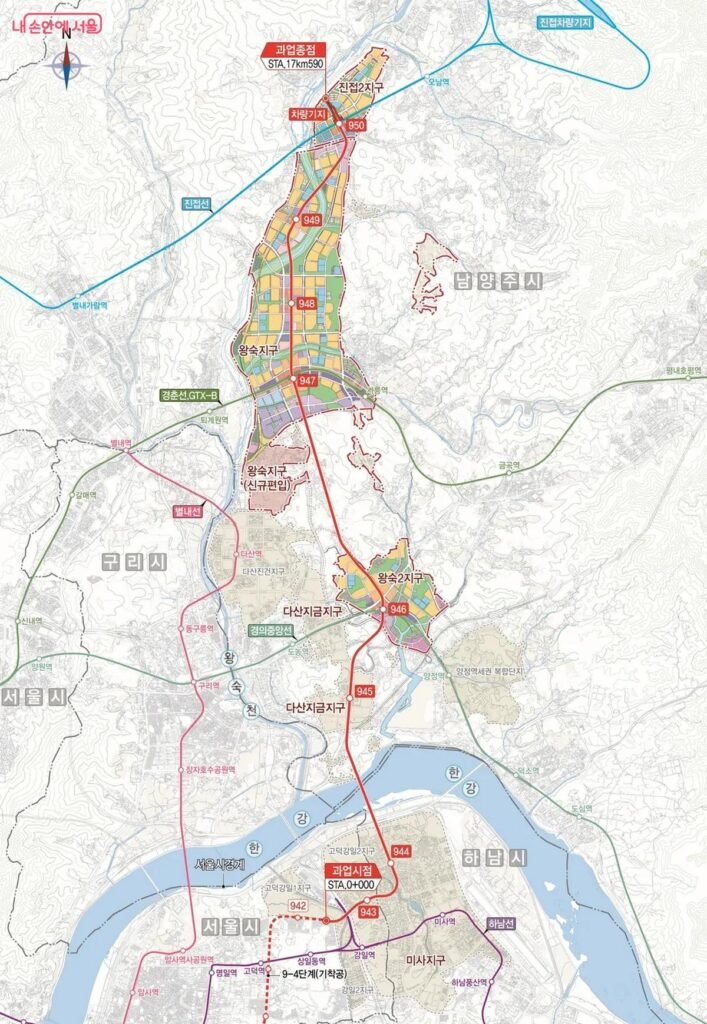
- New Town Development:
- Wang숙 District: This massive project is split into two zones: Wangsuk 1 (52,000 households) and Wangsuk 2 (15,000 households). Construction began in 2023, with initial occupancy starting in 2028 and full completion by 2032.
- Yangjeong Station Area: This 12,000-household project is proceeding on a similar timeline to the Wangsuk development.
- Jinjeop 2 District: An additional development supplying 10,000 households.
- Transportation Network Enhancements:
- Railways: The GTX-B line is in the construction phase with a 2031 opening target. The Line 9 extension connecting Hanam to Wang숙 has been delayed but also aims for a 2031 opening.
- Roads: Multiple road projects are underway to support the new population centers. These include the expansion of Provincial Road 383 (target completion 2028), the expansion of National Route 46, and the creation of new connecting roads between development zones, such as the Ilpae-ro expansion (target completion 2031).
The extensive residential and infrastructure build-out in Northern Gyeonggi contrasts with the industry-focused development strategy unfolding in the province’s southern half.
4.0 Analysis of Southern Gyeonggi Province Development Hubs
Southern Gyeonggi is being systematically transformed into a global powerhouse of high-tech industry, centered on an expansive semiconductor belt. This industrial strategy is supported by massive national-level infrastructure projects, including new expressways and railway lines, all aimed at creating a globally competitive economic zone with advanced manufacturing, research, and logistics capabilities.
4.1 Gwangju City: Enhancing Connectivity and Urban Growth around Railway Hubs
Gwangju City’s development is focused on creating new urban centers around key railway stations, improving its connection to Seoul and neighboring cities.
- Suseo-Gwangju Railway Line: Construction is planned to start in late 2025, with a target opening in 2030. This line is highly significant as it will directly connect Gwangju to Seoul’s affluent Gangnam area via Suseo Station.
- Gwangju Station Area Development (Phase 2): This project will add over 3,200 households. It is currently under provincial review, with a goal for district designation in the first half of 2026.
- Ssangnyeong Districts: The development includes the Ssangnyeong District (3,300 households) and Ssangnyeong 2 District (800 households), with district designation for both expected by December 2025.
- Gonjiam Station Area Development (Phase 2): This 2,000-household project is targeting completion by late 2030. It will be supported by the Second Outer Ring Expressway (Icheon-Yangpyeong section), which is over 50% complete and aims for a late 2027 opening.
4.2 Yongin City: The Epicenter of the Global Semiconductor Cluster
Yongin is the centerpiece of South Korea’s national semiconductor strategy, with monumental investments from Samsung and SK Hynix establishing the region as a globally significant production hub.
- Semiconductor Clusters:
- Yongin Advanced System Semiconductor Cluster (National Industrial Complex): This is a flagship Samsung project with a staggering 360 trillion KRW investment. The timeline targets compensation for land acquisition in 2026 and initial operation in 2030.
- Yongin Semiconductor Cluster (General Industrial Park): This is an SK Hynix project with a 122 trillion KRW investment. Construction of the first fabrication plant is currently underway (2024-2027).
- Supporting Urban and Industrial Developments:
- Yongin Platform City: This 10,000-household urban development is centered around Guseong Station (GTX-A). Construction is set to begin in March 2025, with a completion plan for 2030.
- Idong Public Housing District: Led by LH, this project will supply 16,000 households to support the new industrial workforce. The timeline schedules compensation from 2027-2029, construction start in 2029, and initial occupancy by 2033.
- Road Network Expansion Plan: To support the massive logistical and commuter demands of the semiconductor clusters, a comprehensive plan is in place to expand the arterial road network, with most projects targeting completion between 2026 and 2033.
| Road Name/Number | Project Description | Target Completion Date |
| National Route 45 | Expansion from 4 to 8 lanes | 2033 |
| National Route 17 | Expansion from 4 to 6 lanes | First half 2026 (partial 4-lane opening) |
| National Route 82 | Expansion from 2 to 4 lanes | 2031 |
| Local Road 318 | Expansion from 2 to 4 lanes; construction start planned for 2027 | TBD |
| Local Road 321 | Expansion from 2 to 4 lanes; plan announcement expected H1 2026 | TBD |
| National Route 84 | New 4-lane road construction | 2033 |
4.3 Anseong City: Building a High-Tech Industrial Base
Anseong is focused on developing its industrial capacity, particularly in the semiconductor supply chain, and improving its transportation network to integrate with the broader Southern Gyeonggi economic zone.
- Industrial Development:
- Dongsin Industrial Complex (Semiconductor Materials/Parts/Equipment): This project is being re-promoted after a setback in provincial review. The revised timeline targets a re-deliberation in the second half of 2026, compensation in 2027-2028, and construction starting in 2029.
- Anseong Techno Valley: With most industrial lots already sold, this project is expected to be completed by late 2026.
- Transportation Infrastructure:
- Highways: The Seoul-Sejong Expressway’s Anseong-Sejong section is targeting a late 2026 opening. The Hwaseong-Anseong Expressway has passed its feasibility study and targets a 2030 construction start and a 2035 opening.
- Railways: The Pyeongtaek-Bubal line failed its preliminary feasibility study. However, the Capital Region Inland Line is now undergoing a private investment feasibility study, keeping hopes for rail connectivity alive.
4.4 Pyeongtaek City: A Hub of International Logistics, Industry, and Urban Growth
Pyeongtaek is a multifaceted hub combining international logistics (Pyeongtaek Port), major industrial parks (Samsung), and large-scale urban development.
- Major Urban Developments:
- Jije Station Area Public Housing District: A 33,000-household project led by LH, with construction targeted for 2027 and completion by 2033.
- Hwayang District: This 20,000+ household project has initial occupancy scheduled to start in August 2025, though some infrastructure work has been paused due to union funding issues.
- Brain City: This 18,000-household project has initial occupancy scheduled for July 2026. Currently, 43% of its industrial land has been sold.
- Anjung Station Area: The goal is to achieve district designation in the first half of 2026, with construction expected to start in 2029.
- Transportation Network:
- Railways: The disconnected Seohwaseong-Wonsi section of the Seohae Line is set to open in March 2026, completing a key regional link. Importantly, the extension of the GTX-A and C lines to Pyeongtaek has passed feasibility studies, promising future express rail service.
- Roads: The Pyeongtaek-Osa section of the Pyeongtaek Eastern Expressway is aiming for a September 2026 opening.
4.5 Hwaseong City: Diversified Development from High-Tech to Tourism
Hwaseong features a diverse portfolio of major projects, ranging from large public housing districts and advanced industrial clusters to a landmark international theme park.
- Urban and Industrial Development:
- Jinan Public Housing District: A large-scale project of 34,000 households, with compensation planned for the second half of 2028 and completion by 2032.
- Bongdam 3 District: This 18,000-household project targets compensation in the second half of 2026 and a 2028 construction start.
- Songsan Green City: Priority sales of industrial land are underway to establish a future car cluster within the city.
- Key Infrastructure and Tourism Projects:
- Hwaseong International Theme Park: A major tourism anchor, construction is planned to begin in 2026, with a partial opening targeted for 2030.
- Incheon KTX: With a projected progress rate of 56.3% by September 2025, this line targets a late 2026 opening and will serve the Eocheon station in Hwaseong, providing valuable KTX access.
- Road Network: Major road projects include the Balan-Namyang Expressway (starts Dec 2026), the Hyangnam-Ujeong Route 82 expansion (starts July 2025), and the Pyeongtaek-Siheung Expressway expansion (starts 2028).
The immense industrial and infrastructure investments in Southern Gyeonggi are positioning the region as a primary engine of South Korea’s future economic growth.
5.0 Synthesis and Strategic Outlook
The development landscape across Gyeonggi Province is defined by two distinct but complementary strategies. In the north, the focus is on large-scale residential expansion to stabilize housing in the metropolitan area, supported by radial transportation links improving access to Seoul. In the south, the strategy is centered on creating a globally competitive, high-tech industrial belt, supported by a comprehensive grid of national-level infrastructure. Together, these initiatives are fundamentally reshaping the province’s economic and social geography.
Comparative Development Strategies
| Aspect | Northern Gyeonggi | Southern Gyeonggi |
| Primary Development Driver | Residential expansion and enhanced connectivity to Seoul’s job centers. | Creation of a high-tech industrial belt (semiconductors, future mobility). |
| Key Industries | Media/Culture (Goyang), light manufacturing, and supporting commercial services. | Semiconductors, future mobility, biotechnology, and international logistics. |
| Infrastructure Focus | Radial rail (GTX) and road connections to Northern Seoul. | A comprehensive grid of national expressways and rail lines supporting industrial logistics and inter-city connectivity. |
Forward-Looking Statement
The collective impact of these wide-ranging projects is poised to transform Gyeonggi Province from a collection of Seoul’s satellite cities into a more economically independent and strategically vital region within South Korea. While individual project timelines vary, the period between 2026 and 2030 emerges as a critical window of transformation. During this time, numerous key expressways, railway extensions, and industrial facilities are scheduled to come online. The successful execution of these plans will not only alleviate pressure on Seoul but will also establish Gyeonggi as a formidable economic entity in its own right, anchored by a powerful southern industrial corridor and a stable, well-connected northern residential base.