



01 Market Overview: The Resurgence of Korean REITs
The South Korean REIT market enters 2025 in a definitive recovery phase, successfully reclaiming the growth trajectory interrupted by the recent era of global interest rate volatility. The market has matured from a niche structure into a cornerstone of national asset formation, evidenced by significant expansion in total asset value and listed market capitalization.
| Metric | 2024 | 2025 | Growth |
|---|---|---|---|
| Total Asset Value | ₩100.07T | ₩117.86T | +17.78% |
| Number of REITs | 400 | 447 | +11.75% |
| KOSPI Listed Market Cap | ₩7.90T | ₩9.54T | +20.81% |
The 20.81% surge in listed REIT market capitalization is a critical indicator of returning institutional confidence, primarily catalyzed by active Rights Offerings (유상증자) and general share price appreciation.
"2025 represents the most attractive entry point for Korean real estate in the last decade."
02 The Strategic Shift Toward Enlargement and Consolidation
A primary headwind for the Korean REIT sector has been the "Small-Cap Discount." The market remains characterized by fragmented, single-asset portfolios — limiting economies of scale and creating barriers for global institutional funds.
| Market | Average Market Cap |
|---|---|
| United States | ₩10.5 Trillion |
| Singapore | ₩2.9 Trillion |
| South Korea | ₩0.4 Trillion |
The structural disadvantages include thin trading volumes creating liquidity traps, failure to meet global index inclusion thresholds, and vulnerability to localized tenant or regional shocks.
03 The Dividend Revolution: Transitioning to Monthly Income Models
South Korea is aligning its dividend frameworks with US market standards — transitioning REITs from speculative assets into pension-type vehicles (생활형 투자) that provide predictable cash flow.
Historically, 98% of Korean REITs paid dividends annually or semi-annually, causing high volatility and "blind dividend" problems. In January 2025, the Pre-determined Dividend Amount model was enacted, eliminating blind investing. Monthly or quarterly payouts now make REITs direct competitors for high-yield bonds and bank deposits.
04 High-Growth Vehicles: The Rise of Project REITs
Project REITs (enforced November 2024) mark a fundamental shift from passive asset holding to active urban development, allowing investors to capture alpha during the higher-growth development phase of the real estate lifecycle.
| Feature | Detail |
|---|---|
| Public Offering Exemption | Extended from 2 to 5 years |
| Pre-registration Borrowing | Funds and bonds may be issued before formal registration |
| Tax Deferral on In-kind Contributions | Capital gains deferred until share disposal — valid until December 31, 2028 |
05 Case Studies: Strategic Asset Models in Focus
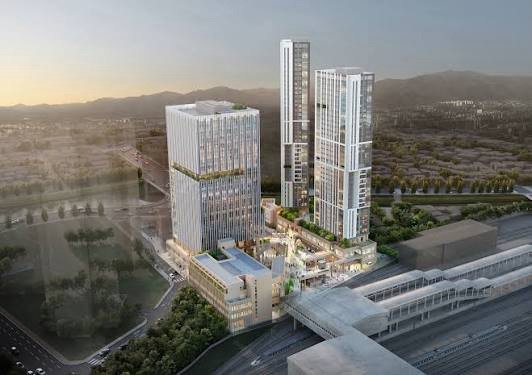
Cheonan Station Innovation District — Mixed-Use Development
The first public-backed project to convert into a Project REIT (December 2025). Its asset mix incorporates housing, knowledge industry centers, and transit-oriented commercial facilities, demonstrating how Project REITs can revitalize declining urban cores through a sustainable, multi-phase model.
Nonhyeon-dong Office REIT No. 8 — Core Office
Located in the Gangnam Business District (GBD) — a tier-one priority for global office investors — this REIT generates stable rental income from institutional-grade tenants and targets strategic asset liquidation at end of holding period to distribute final capital gains.
06 Investor Protection and Future Outlook
The Ministry of Land, Infrastructure, and Transport (MOLIT) has been granted expanded oversight powers including direct inspection authority over REIT subsidiaries (자회사), broadened grounds for revoking business licenses in cases of breach of duty, and strengthened codes of conduct to prevent conflicts of interest between management and shareholders.
Investment Verdict
The convergence of scale expansion through streamlined mergers, dividend transparency via monthly payouts, and development-friendly tax policies — with the deferral window closing in late 2028 — makes 2025 the most attractive entry point for Korean real estate in the last decade. The infrastructure for a sophisticated, liquid, and transparent market is now firmly in place.